
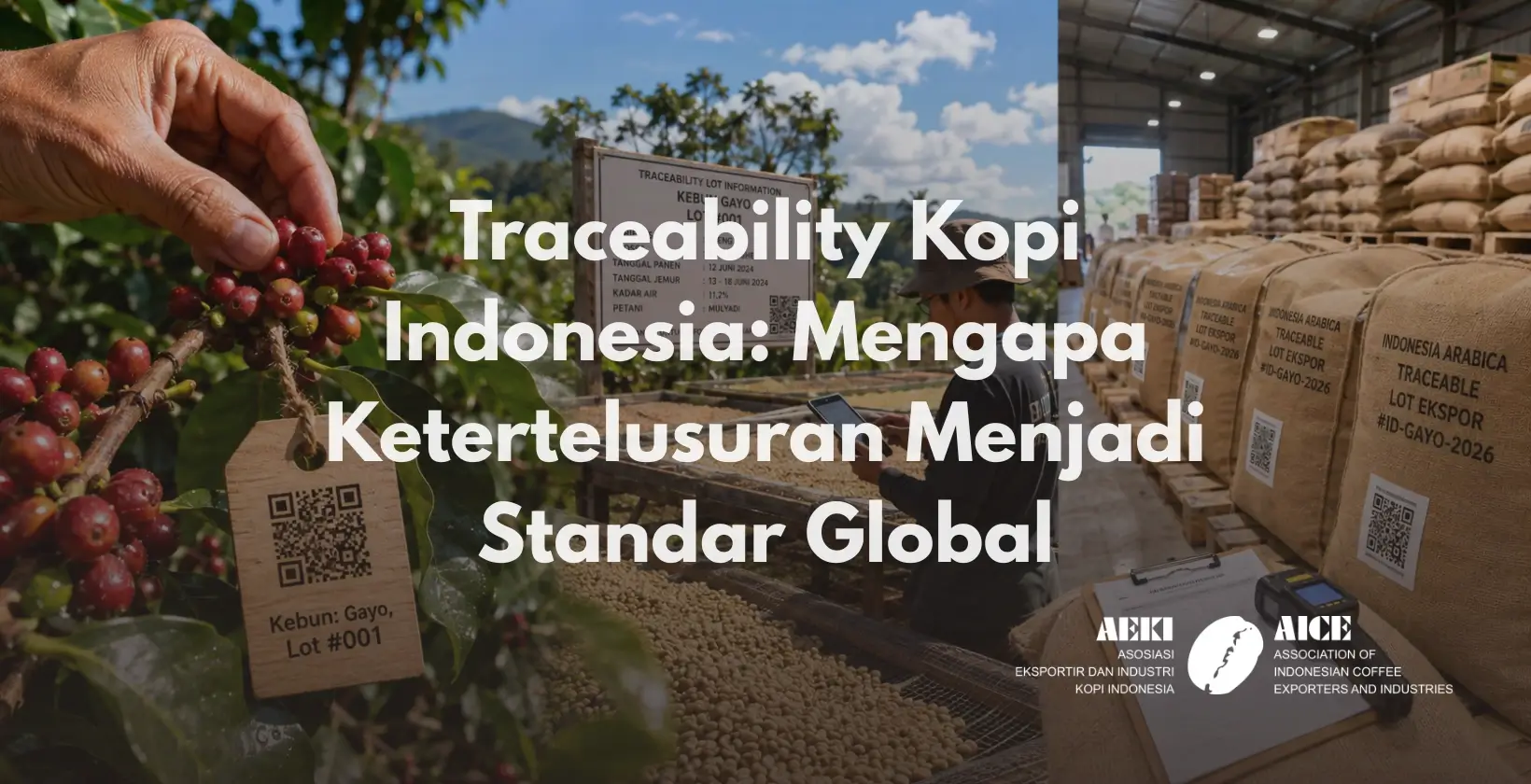


Coffee traceability is becoming a global standard not because there's a single global rule with a uniform format, but because buyers, quality systems, and regulations increasingly demand verifiable proof of origin and the lot's journey. For Indonesian coffee, a lot ideally doesn't stop with the label "Gayo," "Kintamani," or "Flores." The data trail needs to be continuous throughout the coffee's collection, processing, storage, and shipping.
In short:
- traceability links physical coffee with provenance data and lot history;
- vulnerable points arise when lots are merged, split, or processed;
- QR codes or blockchain help, but are not the core of the system;
- The EUDR adds traceability requirements to supply chains heading towards the European Union.
What Does Coffee Traceability Really Mean?
Coffee traceability is the ability to determine the history or location of a product through interconnected records.
ISO 22005 on food chain traceability defines it as a technical tool to help determine the history or location of a product. GS1 then maps traceability through Critical Tracking Events (CTE) and Key Data Elements (KDE).
The practical questions become: “Where did this lot come from, what process did it go through, when did it move, and what lot was formed after that process?”
This differs from simply storytelling origins. Origin stories can enrich a product, but traceability requires records that can be matched back to the physical item.
Why Is Coffee Traceability Becoming the Standard in Global Supply Chains?
There are three main drivers: quality control, buyer needs, and compliance.
Traceability narrows the search when problems arise. If a batch exhibits a storage defect or cupping results are inconsistent, consistent lot codes help trace the process point without having to inspect the entire stock.
Buyers also require information supporting the origin and lot integrity. The commercial discussion can be continued through international coffee buyer requirements to maintain the focus of this article on data integrity. AEKI lists traceability and lot identity as part of the information assessed in supplier readiness.
Regulation reinforces this need. Coffee is a commodity covered by the EUDR. The European Commission stated that the regulation's primary implementation will begin on December 30, 2026.
Suppliers outside the EU that are not directly EUDR operators may still be asked to provide information, including production locations, to enable EU companies to meet their obligations.
For a discussion of the regulations, read the EUDR coffee guide and the EUDR implementation guide from the European Commission.
What Data Should Be Included in Each Coffee Lot?
Don't start with the application. Start with the relationship between things and events.
The simple framework is to know who, what, where, when, and why , then ensure each change remains linked to the previous lot. This approach aligns with the CTE and KDE concepts in the GS1 Global Traceability Standard.
For a single lot of green beans, operational records may include supplier ID, production location, harvest period, incoming weight, process, batch code, storage location, transformation results, and shipping destination.
Ultimately, requirements still depend on the contract and the target market. Not all supply chains require the same level of detail.
How to Build a Coffee Supply Chain That's Unbreakable
The key to coffee supply chain traceability is maintaining data relationships every time coffee changes form, location, or lot identity.
Use five steps:
- Assign a unique ID to each material receipt.
- Record receipt, processing, merging, separation, storage, and delivery.
- When lot changes, save the relation parent–child with the previous lot.
- Reconciliation of incoming volume, process losses, and outgoing volume.
- Reverse test: pick a sack in the warehouse and try to trace it back to its data source.
Spreadsheets can be sufficient for a simple chain if record-keeping is disciplined. QR codes, ERPs, apps, or blockchains begin to provide value when the underlying data is consistent.
Technology cannot fix lot relationships that were not recorded in the first place.
Example: When Three Lots Become One Export Lot
Imagine three groups of suppliers sending parchment coffee with codes P01, P02, and P03 . After hulling and sorting, some of the coffee meets the same specifications and is combined into green-bean lot G07.
Good traceability does not make G07 a new starting point and delete P01–P03.
The system still records that G07 originated from all three lots, including the contribution volume and processing time. If G07 is later split into two shipments, both shipments can still be traced to the original source.
This is where the provenance database differs from traceability : the relationships between lot changes remain alive.
Common Mistakes That Weaken Traceability
The biggest problem is usually not a lack of data, but rather disconnected data.
Farmer names, farm coordinates, photos, and QR codes are of little help if the lot code in the warehouse doesn't match the code on the processing or shipping records.
Mixing with unknown sources also requires vigilance. In the EUDR, the complexity of the supply chain and the risk of mixing with products of unknown origin are factors considered in the risk assessment.
Traceability is also not a quality certification and is not automatic proof that coffee has met all sustainability criteria.
Traceability is an evidence infrastructure. Claims of quality, sustainability, or compliance still require their own basis and documentation.
Coffee Traceability Checklist
Before a system is used for market purposes, check six things: unique lot IDs, inter-lot relationships, volume reconciliation, location and time records, forward and backward traceability, and the ability to export evidence without rebuilding the database from scratch.
For a more formal system framework, use ISO 22005 on food chain traceability as a reference. Trade administrative requirements should be reviewed separately through the Indonesian coffee export document guide.
Conclusion
Coffee traceability isn't about having the most sophisticated QR code, but rather maintaining the connection between the physical coffee and the data throughout the lot's journey.
A simple but consistent system can be more useful than a complex platform that fails to maintain inter-batch relationships.
For the Indonesian coffee supply chain, this capability helps with quality control, meeting buyer data needs, and preparing for increasingly specific compliance. AEKI-AICE places quality, traceability, market access, and sustainability as part of its focus on strengthening the national coffee industry.
Once the traceability system is in place, the next step is to ensure the data aligns with the trade needs and requirements of the target market.
Through the AEKI-AICE membership package , access to market and regulatory information is available as well as, depending on membership level, assistance regarding export procedures and documents such as ICO, SKA/COO, and PEB.
Explore the AEKI-AICE membership packages to see which information and support services best suit your needs.
FAQ
1. What is coffee traceability?
Coffee traceability is the ability to trace the origin, history, and movement of a lot through data that remains connected throughout the supply chain.
2. What is the difference between traceability and transparency?
Traceability answers "Where does this product come from and move from?" , while transparency relates to what information is disclosed to others. Systems can have more detailed internal traceability than the information displayed to consumers.
3. Does coffee traceability have to use a QR code?
No. QR codes are a means of accessing or connecting information. The quality of traceability is still determined by the accuracy of the data and the relationships between the lots behind it.
4. Is blockchain mandatory for coffee supply chain traceability?
No. Blockchain is a record-keeping technology. A spreadsheet-based system or a traditional database can also be used as long as lot identities, product changes, and movement of goods are consistently recorded.
5. Is coffee traceability the same as EUDR compliance?
No. Traceability has a broader function. The EUDR is a specific European Union regulation that uses traceability information, including production location data, as part of its compliance mechanism.


